
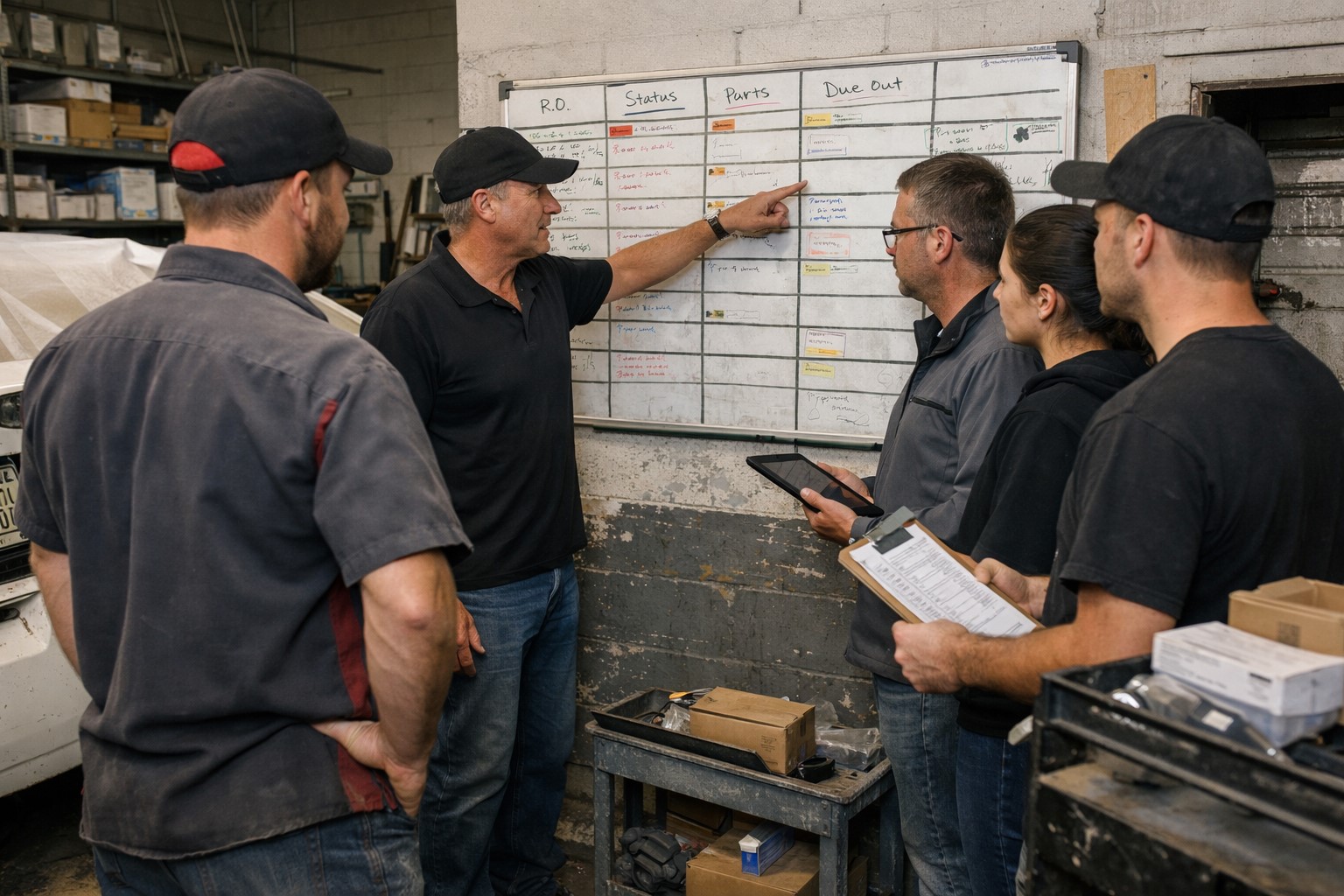
A bumper job is waiting on clips, an SUV is still pending supplement approval, a calibration slot has not been confirmed, and a finished vehicle cannot leave because payment is still open. By 9:00 a.m., the collision repair shop is already re-sequencing work around uncertainty. That is what happens when the day starts with assumptions instead of a production control routine. A 12-minute morning production meeting works when it is built to create movement, not conversation.
The meeting should start at the production board and stay there. Review only what changes today’s repair order (RO) flow: vehicles due in, vehicles due out, parts-held jobs, supplement approvals, calibration or sublet dependencies, and any delivery blocked by paperwork, payment, or customer contact. If a topic does not affect whether a vehicle moves today, it does not belong in the 12 minutes.
Who speaks matters. The production manager or owner leads. The estimator speaks to supplement status and insurer response timing. The parts person confirms arrivals, backorders, and anything that makes a job not buildable. The front office covers delivery holds, customer approvals, and rental or pickup coordination. Technicians should not give long story versions. They should speak only when a job has a real blocker that changes today’s sequence.
Each update should follow one format: repair order, blocker, next move, and owner. That keeps the meeting moving and prevents drift. If a quarter-panel job is waiting on a sensor bracket, the answer is not a five-minute recap. It is: “RO 2146, parts-held, sensor bracket missing, parts called vendor at 8:10, update due by 10:00.”
Escalation is the real purpose of the meeting. If a blocker is already old, threatens today’s delivery, or is tying up a stall with no clear next step, it leaves the meeting with one named owner and a deadline. That includes insurer silence, missing parts, customer-pay decisions, sublet scheduling, or blueprint gaps. The group identifies it fast, assigns it fast, and moves on.
What should never be discussed there? Full estimate debates, blame, technician coaching, yesterday’s arguments, vendor storytelling, or broad process redesign. Those belong in a separate conversation.
A morning production meeting is not for explaining why the collision repair shop has problems. It is for deciding what gets unstuck before the day disappears.

One honest question for collision repair shop owners: what is the most common thing that hijacks your morning production meeting right now?